

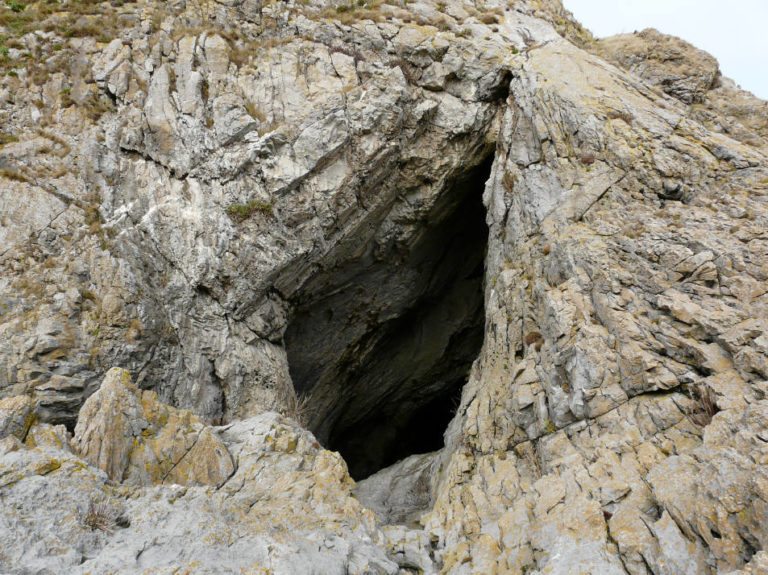
The discovery of the “Red Lady of Paviland” in 1823 made Goat’s Hole, one of the Paviland Caves, one of the most well-known archaeological sites in Europe. Reverend William Buckland from the University of Oxford discovered a red skeleton in Goat’s Hole that he initially identified as the remains of a tax collector who had been murdered by smugglers before cycling through many other strange theories for their origins.
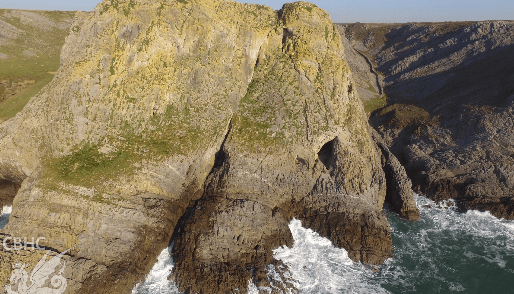
In 1822, Buckland received a gift that included a basket full of animal bones and the tusk and head of a mammoth. Lady Mary Cole of Penrice Castle, Gower, had sent the discoveries from Paviland Cave. Buckland was so intrigued by the package he decided to excavate the region. Goat’s Hole is a limestone cave that is usually cut off by the tide for most of the year. Buckland visited the Gower coast in December when the tide was at their lowest. This meant, he could immediately excavate the region.

Within a short period, Buckland discovered an intact grave of ochre-stained human bones without a skull and artefacts. Upon excavation, ivory items such as rings and rods, a clutch of periwinkle shells, and carved flints were discovered surrounding the remains. They were taken by Buckland back to Oxford.
When first inspecting the red skeleton, Buckland theorised that it was the remains of a ‘murdered person’ and most likely belonged to a Custom’s Officer who had been murdered by smugglers. He came to this conclusion because the Paviland Caves were often used by smugglers to hide contraband. Hound’s Hole was an infamous cave nearby Goat’s Hole that has been said to “many a time filled with kegs of brandy”. However, Buckland soon moved on from this theory, believing the bones to were the remains of a woman.
Based on his knowledge of Welsh customs, Buckland posited that the remains belonged to a witch as there was a “blade bone of mutton” alongside the skeleton. He claimed this bone blade was used as a conjuring tool. This theory also did not last long. The presence ivory jewellery led Buckland to contend that bones belonged to a “painted prostitute”. This prostitute allegedly used the shell beads present at the site as a means of gambling. Buckland also theorised that the rings were made from Roman elephant ivory. He argued that the prostitute must have been killed during the biblical flood when she was trying to seek shelter from the rising tides in the Paviland Caves. He preferred this theory as it fitted his religious worldview, but it was also incorrect.
In 2008, radiocarbon-dating techniques conclusively showed these bones belonged to a male, aged 25–30, who stood about 173cm in height buried around 33,000 years ago. During this period, Paviland would have been situated on a cliff overlooking a grassy plain at least 60 miles inland. Mammoths, woolly rhinoceros, huge deer, bison, and reindeer would have all been abundant in the landscape. Even with this discovery, there is still much debate around the identity of the young Palaeolithic man. The leading theory is that he was a Palaeolithic hunter, but some have argued that he could have been some kind of shaman or spiritual figure.
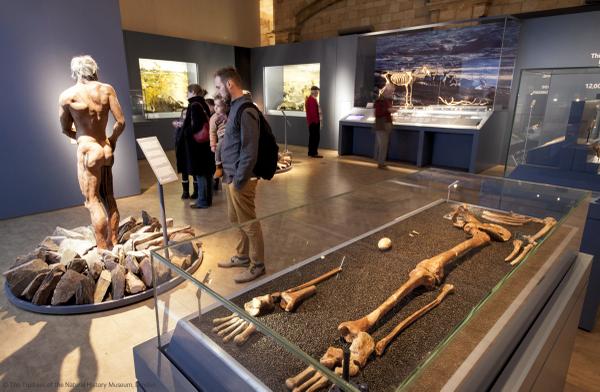
Currently, the hyena jaw bones are displayed at Swansea Museum, while an ivory staff is stored at St. Fagans National Museum of History in Cardiff, but the red skeleton remains on display at the University of Oxford’s Museum of Natural History. There has been much debate around returning the red skeleton to Wales to be displayed under the name “Welsh Elgin marbles”. Despite this, the red skeleton remains in Oxford where they are well maintained.
Further Reading:
- Paul Ferris, Gower in History: Myth, People, Landscape, (Hay on Wye: Armanaleg Books, 2009).
- Marianne Sommer, Bones and Ochre: The Curious Afterlife of the Red Lady of Paviland, (London: Harvard University Press, 2008).
- Ffion Reynolds and Jacqui Mulville, “Red Lady of Paviland: the story of a 33,000 year-old-skeleton – and the calls for it to return to Wales”, The Conversation (2023) Available at: https://theconversation.com/red-lady-of-paviland-the-story-of-a-33-000-year-old-skeleton-and-the-calls-for-it-to-return-to-wales-197204
- Stephen Aldhouse-Green and Friends of the National Museum of Wales, Paviland Cave and the ’Red Lady’: A Definitive Report, (published for the SCARAB Research Centre of the University of Wales College, Newport and the Friends of the National Museum of Wales by the Western Academic & Specialist Press, 2000).

 Pirates of Port Eynon
Leave a reply to radsupernaturally593bd6ebb3 Cancel reply