

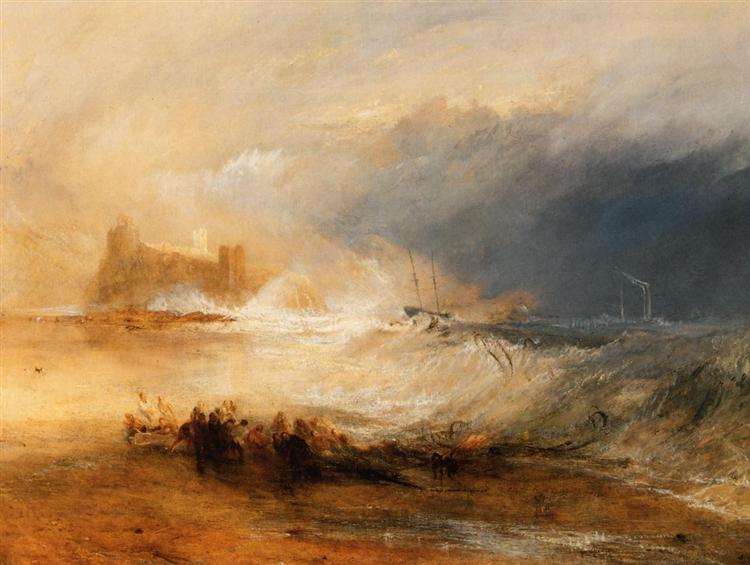
Wrecking is the practice of taking valuables from a shipwreck which has run aground close to shore. Wrecking was another part of Gower’s smuggling trade, as goods that were washed ashore from a wrecked ship were regarded as common property. The prevailing south-westerly winds of the Bristol Channel collide with the Gower Coast which in stormy weather caused ships to run ashore. There are tales of professional wreckers with lanterns luring mariners on to the rocks. As such, wrecks were part of the local economy and always played a part in community life.
“Oh Lord, let there not be wrecks. But since we know there must be wrecks, let them be here, not Rhossili” – A popular prayer in Port Eynon
While serious wrecks are infrequent in the modern era, they were common throughout the 18th and 19th centuries. Rhossili Bay had the most frequent wrecks on the Gower coast. Facing the south-westerly winds of the Bristol Channel, with a three-and-a-half-mile long shore-line between rocks at either end, Rhossili Bay was uniquely challenging for sailors not to run aground. Towards the northern end of the bay, a piece of lobsided machinery can be seen at low tide. This site is the remains of the City of Bristol, a paddle-driver steamer which ran aground in 1840. Villagers had come on to the beach and were able to hear “the cries of the unfortunate persons” aboard the City of Bristol. As lifejackets had not been invented yet, only two men survived. The ship’s cargo of several hundred pigs, fifteen bullocks, some barrels of grain and 120 flitches of bacon littered Rhossili Bay. The local community cleared the beach within hours before any Revenue Men appeared from Swansea.

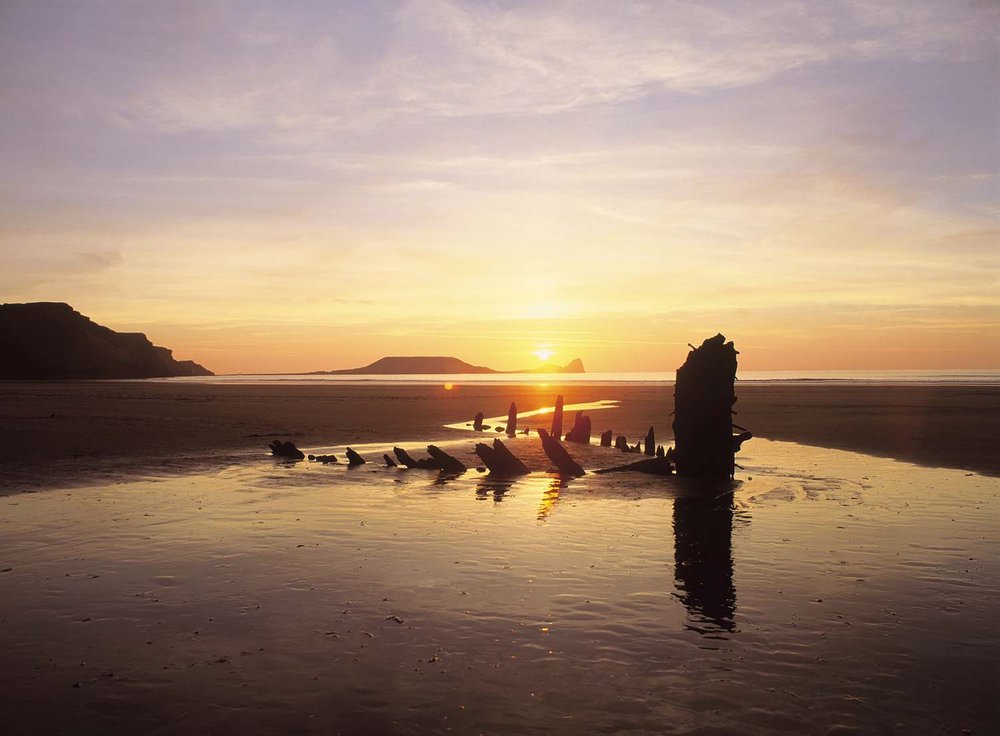
A similar situation happened in 1887, when the Helvetia was taken by heavy winds from Mumbles to the coast of Rhossili. The local community looted the vessel, leaving only the hull behind. Some time later, a local entrepreneur bought the wreck from Swansea Customs because he knew it had a valuable copper keel, but the hull had settled into the sand. It was impossible to remove the copper and had to be left in the hull. Today the half-buried ribs of the Helvetia’s wooden hull can still be seen at low tide.
Near the Helvetia was another wreck which had famously contributed to the local economy more than once, but unfortunately, the details are lacking. The wreck supposedly contained treasure consisting of silver dollars, half-dollars, and pieces of eight. They were all found in a specific region of Rhossili Bay and are assumed to have been laying there for 300 years. This is based assumption that this treasure belonged to a Spanish vessel which was wrecked in Rhossili in the mid-17th Century. In 1807, the Rhossili treasure got into the newspapers, with a second-hand account in the Cambrian. The article claimed a local had discovered “a cask of iron wire” and approximately 5kgs in weight of Spanish dollars and half-dollars dated 1625. It was theorised that these “formed part of the cargo of a rich Spanish vessel from South America called the Scandaroon galley, which was wrecked on that part of the coast upwards of a century since.” When the Cambrian followed up this report in 1834, they gave a more exciting account of what happened in 1807. Sand had “drifted very unusually,” and “part of the wreck, in a very decayed state, became visible, and a great quantity of dollars, with some iron and pewter, was then dug up from some depth in the sand.” Many in the local community were “much enriched,” but “the spot where the vessel struck being open at four hours ebb tide, and the sand having returned to its old quarters, the money-hunters were obliged to desist in their attempt.”
Of course, Rhossili was not the only bay that had frequent wrecks on the Gower coast. In Pwll Du, ships would run aground on the rocks in the shallow bay and were often looted by the locals. By the time customs were notified in Swansea, the wreck would have been stripped and the cargo was removed to safe hiding places. For example, a timber ship was wrecked off the coast of Pwll Du loaded with floor joists, soon covering the bay with this valuable cargo. Within hours, the beach was completely cleared and the coastguards were unable to find much of the cargo. Before long, new wooden sheds and poultry houses appeared in the gardens throughout Pennard. According to local legend, the floors of the Beaufort Inn and the Ship cottage were repaired with the same timber stolen from the wrecked ship. The Beaufort Inn had a long history of association with smuggling gangs in the area, helping them hide and store contraband. The roof timbers of the Beaufort Inn had quarter inch holes, that could only have been made by a marine borer, so when the inn was first built in the 1830s, timber from a wreck was likely used.
While wrecking in Gower has mostly subsided in the modern era, some in the community still engage in it from time to time. In her book, Heather Holt recounted that “wrecking continues to be one of my favourite pastimes. You never know what you’re going to find.”
Further Reading
- George Edmunds, The Gower Coast, (Bristol: Regional Publications Ltd, 1979).
- Paul Ferris, Gower in history: myth, people, landscape (Hay on Wye: Armanaleg Books, 2009).
- Peter Rees, Gower Shipwrecks (Swansea: C. Davies, 1978).
- Heather Holt, Pwlldu Remembered: The Story of Gower’s Smallest Village (Swansea: Published by the author, 1996).
- Latimer Davies, Pennard and West Gower (Swansea: W. Spurrell, 1928).
- Richard Platt, Smuggling in the British Isles: A History, (Stroud: Tempus Publishing, Ltd., 2007).
 Pirates of Port Eynon
Leave a comment