

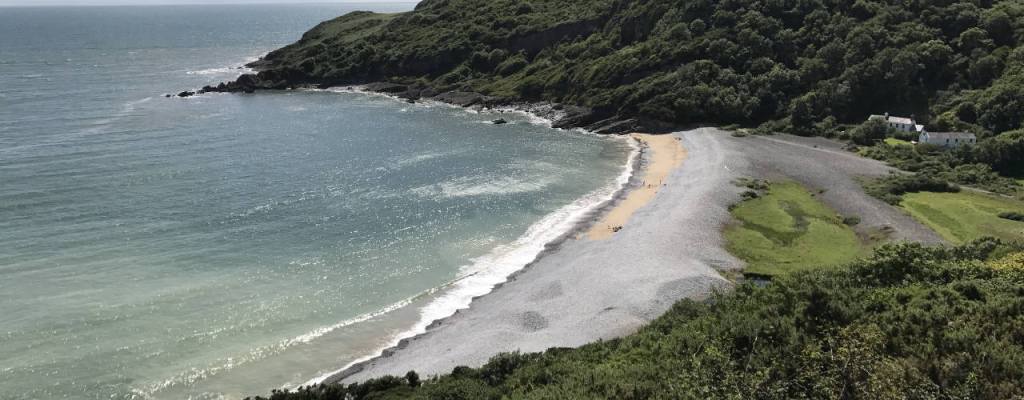
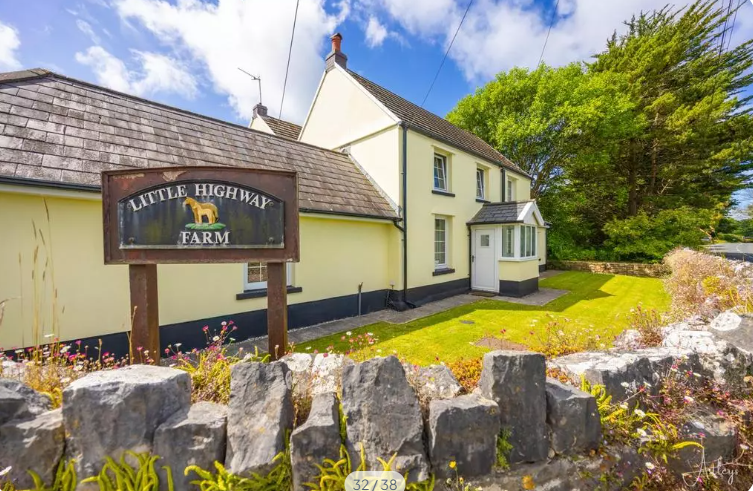
John Griffiths of Pennard is most famous for his association with William Hawkin Arthur, acting as his second in command over the smugglers of Brandy Cove. Griffiths based his operations out of Little Highway Farm which was situated next to Arthur’s Great Highway Farm in Pennard and together they controlled smuggling in the area.
In the nave of Pennard Church there are three tablets, one of which is in memory of John Griffiths, who died in 1780, aged 54. The Griffiths family is mentioned in parish documents as early as the 15th Century. Just as William Hawkin Arthur took over the family business, John Griffith’s son of the same name continued his father’s role.
It is said that Griffiths and his son oversaw the landing of illegal contraband at Brandy Cove and Pwll Du beach before transporting the goods by pack-horses up Bishopston Valley, then along Smugglers Lane to the Highway farms. Once the contraband had been transported to the Highway farms, they were stored and hidden until it was sold into the local community.
Griffiths and his son possibly enjoyed forty years of profitable trading before any serious attempt to curb their activities. The local inhabitants of Pennard turned a blind eye to the smugglers of Brandy Cove, with many of them being directly involved in the trade. It is said that every horse from the surrounding farms were used to create a procession of pack-horses carrying goods down Smuggler’s Lane. Local drinkers at the Ship bar were regularly served illicit spirits that had been landed at Brandy Cove or Pwll Du beach. As the smugglers at Highway became the most notorious in the Gower, only the revenue service was unaware of their activities.
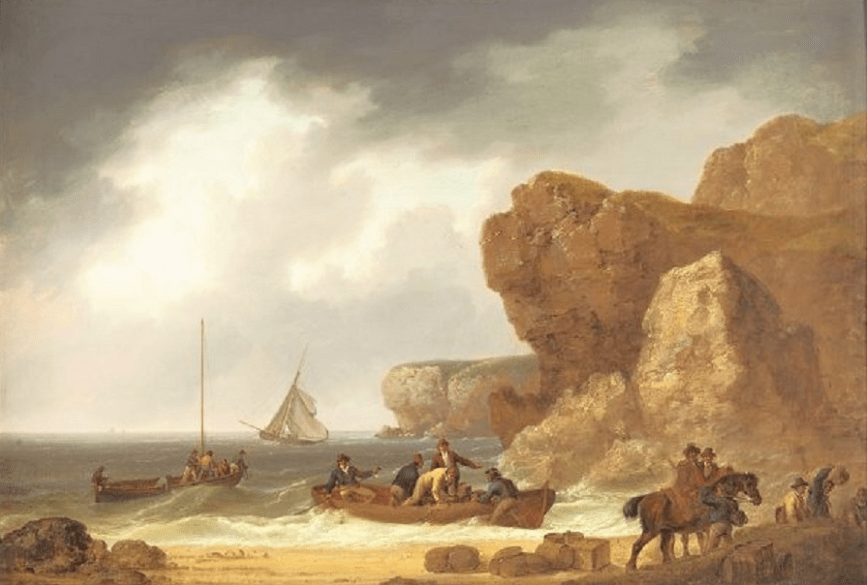
After many years of unhindered trade, the revenue service finally caught wind of smuggling in Gower and started a series of raids on the Highway farms starting in 1788. It took until 1804 for the revenue officers to successfully raid the Highway farms and find contraband at the properties. At Little Highway Farm, the revenue officers found casks littering containing illicit spirits littering the land and many pack-horses. 420 casks of spirits amounting to nearly 3,000 gallons were seized at the Highway farms and was one of the biggest raids in the history of Gower. However, not all the casks arrived at the Swansea Custom House as nearly 200 local residents attacked the revenue officers.
“… some of them were much intoxicated, very clamorous and threatening they be allowed to drink” – Custom Officer Beaven, 1804
This seizure marked the end of the smugglers of Brandy Cove. Arthur’s gang broke apart over the next year and became disorganised smaller gangs that could be easily dealt with by the authorities. In 1805, Custom Officer George Beynon stationed at Rhossili Bay surprised a gang of smugglers landing goods. The smugglers were able to escape but they left behind over 100 casks of brand, Gineva and wine. Then in 1807, a large seizure was made at Middleton. 30 kegs of brandy and over £1,200 worth of tobacco was found in a haystack. The tables had finally turned on the smugglers, and the revenue service was taking control of Gower’s coastline.
While the Arthur family moved away from Pennard, the Griffiths family remained on Little Highway Farm and stayed in the Gower until the modern day. Today, a descendent of John Griffiths, Walter Griffiths, lives in Bishopston whose father, Samuel Griffiths, was a councillor of long standing and a former church warden. During an interview with the local press, Samual Griffiths seemed complacent over his families ties to smuggling in the 18th Century stating, “any of our forebears who lived in Pwll Du or High Pennard at that time would have been similarly implicated”.
“… his Hanoverian Majesty lacked for nothing, whereas Pennard folk in those days lost a lot of sleep in order to add a little excitement and comfort to an existence all too drab and dreary” – Samual Griffiths
Further Reading
- T. Elias and Dafydd Meirion, Smugglers of Wales, (Llanrwst: Gwasg Carreg Gwalch, 2017).
- K. Watkins, Welsh Smugglers, (Cornwall: James Pike Ltd, 1975).
- P. Ferris, Gower in History: Myth, People, Landscape, (Hay on Wye: Armanaleg Books, 2009).
- H. Holt, Pwlldu Remembered: The Story of Gower’s Smallest Village (Swansea: Published by the author, 1996).
- M. Gibbs, “Brandy for Parsons,” Gower, vol.24 (1973) pp.44-50.
- C. D. Morgan, Wanderings in Gower: A Perfect Guide to the Tourist, with All the Lays, Legends and Customs, and Glossary of Thye Dialect, (Swansea: printed at ‘The Cambrian’ office, 1886).
 Pirates of Port Eynon
Leave a comment